Showing posts with label theatre. Show all posts

21 November 2007

I, Sulu

The technical box of a theatre is a unique sort of place. It's a place of power and a place of separation. At the push of a button, the whole world can go light or dark. Yet the finger behind the button remains somehow hidden.

The tech side of drama is not entirely unfamiliar to me, and I was there again, with more button-pressing and fader-pushing responsibilities than usual, for our recent performances of The Mourning Primrose, by the Finn-Brit Players' very own Z for Zorro, charnel doze.

Running the lights is a bit like manning the helm on the bridge of the Enterprise. The mission won't go on without the buttons being pressed, but the direction is set by a higher authority. Furthermore, there are other guys down in the engine room who do the stuff that actually makes the buttons work. Nevertheless, with a wide array of toys to play with, the experience can be a touch on the nervous side.

The Primrose crew were fortunate enough to have an excellent Scotty-style chief engineer, in the form of a former roadie called Ted, running the theatre with admirably enthusiastic discipline. We had a magnificent Kirk leading from the captain's seat, and with our theatrical context of historical swashbuckling, Trekkies will not forget that helmsman Sulu had ancient weaponry as a hobby.

Warp seven, aye sir!

22 May 2007

Luvvy stuff

Slowly, the adrenalin recedes. There are some shows that one is happy to leave behind, and there are some that one wishes to carry along as a constant companion. The Bald Prima Donna is going down in the latter category. It was a buzz.

It was, of course, a big thrill that we had full houses at the end of the run. And although we started on low audiences, this did have one happy side-effect: the incomparable sight of charnel doze launching onto the empty front seats to yell 'cock, fowl, duck' at the surprised inhabitants of the rows behind.

It's sometimes difficult to put a finger on exactly what makes the journey of a production worthwhile, but on this occasion let's point to the nub with a public appreciation of my wonderful cast. I know at least half of them will be reading.

Thank you, people! You are and were all fabulous. Big hugs to every one of you.

Transience is one defining aspect of live theatre. This one, for sure, will live on in dreams. In the nicest possible way.

14 May 2007

Two bits of an amateur director


Acres of forest have been sacrificed to writing about theatre directing, and I have little to add that is original. But a small part of this occasional amateur theatre director's blog will be given over to two things that, for me, make the restless nights, knotted stomach, greying hairs, and dark hours of self-doubt almost worthwhile.

First, I like to work with people rather than technical effects. It's my personal taste, and as I do this stuff in my spare time, I don't see why I should be forced in a different direction. The plays that I have directed with The Finn-Brit Players reflect this preference: Absent Friends by Alan Ayckbourn, An Inspector Calls by J.B. Priestley, The Bald Prima Donna by Eugène Ionesco, and a number of original works by fellow group members. They are different genres of theatre, but they live primarily through actor, character, and interaction. More technical aspects such as lights, sound, costume, set, and props elevate these, but do not become a spectacle in their own right.

This is because I get my jollies by trying, sometimes helping, occasionally managing, to feed stimuli and ideas into an actor's process of creating a stage being. It may result in a character, caricature, or another form of stage presence, but it should be a living organism, at ease with the rest of the theatre piece.

I realise that this may sound terribly pretentious, but I feel that if I can establish a solid frame for the work, then the actor will produce something more dynamic, more real, more 'them' than anything that I could impose. The biggest challenge occurs if an actor's creation clashes with the balance of the piece as a whole, but with a sensitive actor that leads to a joint exploration of possibilities rather than a battle of wills. And when an actor clicks, and the stage being starts to form independently, that is a magical part of the creative process. It cannot be forced at any particular moment. It often comes when unasked. And it is very special.

Having said that, the second thing that gives me a kick is one of the more technical issues, and that is the creation of a space.

Being a somewhat itinerant group, we get to do quite a bit of this. We arrive at a venue. There is clutter. There may be boxes of cables, stacks of chairs, and remnants from other people's productions. We start work by poking around a bit. Gradually, an area is defined. A couple of lights are hung or focused. If it's a black box, some seats are arranged. Then, at a moment that it is almost impossible to define, you look up to find that the space has woken. It is alive. It recognises your presence. It has become a theatre.

Usually it is late in the evening. Usually the only people around to witness this are a handful of stage crew. But at this point, if you're lucky, it is finally possible to know for certain how the work from the rehearsals will fit into context. The space becomes an ally.

I have a suspicion that matching the two elements that I have picked out here is a key to avoiding much of the friction that can occur during a production. If an actor creates a character and then finds that the space does not support their work, it can be terribly frustrating to feel that several months of creative effort needs to be reshaped in maybe just a few hours. On the other hand, if a crew member gives life to a space and helps it to breathe, an emotional bond is formed with that space. If an actor then arrives with demands rather than appreciation, it can feel as if a stranger has violated a sanctuary. Mutual respect is essential: cast, crew, and space. Even, every now and then, director!

But so much for theory. Come and see the result.
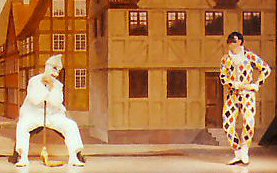
Eugène Ionesco. The Bald Prima Donna. On now.

29 April 2007

The nightmares have begun

Short-range forecast: expect disturbed sleep patterns and erratic behaviour.

Every time I direct. About two weeks before opening. Half-waking at three in the morning. Panic-struck delirium. Convinced that I should be at rehearsal ... paying for licences, buying props, finding missing stage crew, hanging lights ... selling set, banging nails into actors, and teaching tickets how to sing....

Eugène Ionesco. The Bald Prima Donna. Opens 12 May.

23 April 2007

What the ----?

Dammit, I've been tagged again. List five obsessions. Huh! Thank you, Anna MR. Not. I shall sulk in the corner of the playground after this one.

First, I don't think I have any behaviour that would be psychologically labelled as obsessive, though I am pedantic on occasions, for sure. And I do get moody about certain things. So I will transmogrify this challenge (because I can, because it's my blog) into five things that I dwell on a little more than is healthy for me. That's close enough to the Oxford definition of obsess, which is "preoccupy continually or to a troubling extent."

1. Words
I spend a lot of time trying to find the right ones, and often getting them wrong. Read the paragraph above as an example. Go to the poetry label for other evidence. I also read far too much into what other people write to me. No further discussion at this point.

2. Theatre
I do it because some force that I don't quite understand compels me. Do I enjoy it? Sometimes I do; sometimes I don't; often I really don't know. Go to the theatre label for evidence. No further discussion at this point.

3. Crewe Alexandra Football Club
The obligatory professional male sports entry. It's the football club in the town where my family lived when I was young (aged 4-9). It's the club to whose matches my brother, seven years older than me, was taken as a spectator. And the club to whose ground I was not taken. And thus, to prove that I never got over it, the club whose results I look for first when I get the chance, and whose first eleven I could almost recite by heart. But won't. Because I'm not obsessed.

4. Seeing Tony Blair tried for crimes against humanity
No, I don't know what the outcome would be. Law, and especially international law, is complex. But he personally sanctioned a military invasion of Iraq without a mandate from the United Nations (the Secretary-General felt it was "probably illegal"), and without a proven clear and present danger against his own country, resulting directly or indirectly in the deaths of uncounted hundreds of thousands of people. The legal precedent that arises from this must be decided by the international community, and not by one or two individuals who are more concerned with lining their own pockets and covering their own backs. Whichever way the argument goes, the argument must be had. Or the same mess will happen all over again.

5. Not being a creep
Alright, I've saved the worst until last. This is the one that you've been waiting for. And it's partly the difficulty of proving a negative. Because if Tony Blair turned up at my door and asked me to prove that I don't have weapons of mass destruction, I just don't have the necessary paperwork. And if the Thought Police turn up and ask me to prove that I'm not a creep, well, I'm not sure if I kept the certificate.

But why should I be worried about this in the first place? Could it be that, as an averagely sensitive and fairly observant guy, I've just seen too many examples of deep-creep displayed by members of my own gender? There are, let's face it, plenty of blokes out there who have 'chat-up' techniques that would turn milk if used at the breakfast table.

Or is it that through some coincidence of cultural experiences (formative decade, country, class, religion, literature), I have just been inculcated with the idea that a male who rather likes a female and says so is automatically a predatory, sexually harassing fiend who ought to have his balls Bobbitted? After all, I grew up in the time of the 'all men are potential rapists' mantra. And it took me a depressingly long while to realise that many women actually like being with a man, and may even go so far as to not find consensual sex to be a hideously disgusting war crime.

What is more, let us refer again to the theatre thing. I seem to have found a nice line in stage portrayals of just the sort of creep that I detest (or fear, for whatever reason). The ruminatory role of Father in Pirandello's Six Characters in Search of an Author is a case in point. He went to a brothel and found his stepdaughter working there. The exact point at which he discovered that it was his stepdaughter, and what he did when he made this discovery, remain shrouded as elements of an incomplete theatre text. Secretly, he probably enjoyed a lot of the experience and subsequently loathes himself for it, amid his frequent and rambling self-justifications. Now there is an obsessive.

Anyway, the point here is that, having expended a large amount of physical and emotional energy on creating a stage character like that, it is difficult to just shake it off. At one point during our run of Six Characters, I almost felt as if Father was real. It is a huge role in terms of lines, and the level of concentration that I found necessary as an actor meant that I sank into quite dark areas of my mind. For maybe an hour, Father came in and took over the rest. Such an experience must have an influence on an actor. I don't mean in the way of becoming more like the character, but in the way of having to understand and analyse the sort of emotional life that the existence of the character brings to light.

So. I don't want to be one of those creepy guys who hang around certain sorts of pubs, clubs, and public transport. I don't want to be a potential rapist. I don't want to cause anyone any physical displeasure or emotional trauma. I don't want to be the sort of person who leaves a room to a chorus of sighs of relief and embarrassed giggles. And while there must be a way for a male to be sexy and attractive, and to make a legitimate romantic approach in a clean, non-creepy, non-predatory, non-aggressive manner, the fine line between what people consider appropriate and inappropriate is a damn difficult one to judge.

And trying too hard not to be creepy can just make you ... well ... creepy.

There you have it.

Now, as promised, I'm going to sit on my own in a quiet corner of the playground and not bother anyone for a while.

31 March 2007

Just another love-sick poet

As reported by the worthy charnel doze, another season of Poetry & Jazz has come to an end. This, though, was my first as a performer. What is more, it was the first real-world (non-blog) public airing of my poetry. Read my poems here, here, and here.

It's an odd performance experience. The poet-performer is thoroughly exposed to the audience in an intimate café setting. No twitch, fumble, flicker of the eye, momentary lapse, or badly chosen word gets missed. This led to a situation where I, as a performer, felt that perhaps I put up more emotional shields than would have been the case on a normal stage. I made little eye contact, as this disturbed my concentration. I gave very little physical embodiment of the poetry, as the space was restricted.

The response was good, but two comments stay with me. One audience member congratulated me with the words "well acted", and a friend told me that a companion had thought me "arrogant".

Ah well. If this was my attempt at presenting myself, rather than a character in a play, there's some food for thought before I try it again.

06 March 2007

When theatre and anti-theatre collide

Eugène Ionesco's The Bald Prima Donna. And first off, don't start on about how it should be The Bald Soprano, or The Bald Singer, or anything else so pointlessly emasculated. La Cantatrice chauve. The flavour is the operatic equivalent of a prima ballerina, right? With an extra hint of the exotic thrown in for free. And nothing at all to do with Britney You-know-who. Maybe.

Anyway, it's the show that I'm directing with The Finn-Brit Players for production in May. I'll get a plug in early: it's gonna be a blast!

Reactions to this choice of play vary. The majority look slightly puzzled, as if they feel they should have heard the name but can't quite place it. Some smile enigmatically and use words like 'brave' and 'challenging'. And a fabulous few brighten perceptibly and say 'wow!'

I have wanted to explore some Ionesco for a while. This play was already on my list to examine more carefully when, a few years ago, I happened upon a production of The Chairs at the Edinburgh Fringe. That created such a fantastic atmosphere from an almost empty auditorium that I knew there was something to be done.

One of the main issues is that The Bald Prima Donna presents an Absurdist 'passing time pointlessly' scenario alongside a parody of theatrical techniques. (And here I do take issue with the translation that changed the French 'anti-pièce' to the English 'pseudo-play'. This is anti-theatre.) We get both the tragicomedy of pointless small talk posing as real conversation, and the satirical finger-poke at falsehoods in narrative development and storytelling, including abandonment of any pretence of rationality.

Opening that up, and turning the simultaneous time-wasting and parody-of-time-wasting into theatre that is both watchable and true to the original intent ... now there is a challenge. And as we approach the business end of the rehearsal schedule, it's time for the pseudo-inaction to become positively statically charged.

23 January 2007

More sex please, we're Finnish

Yesterday I went with a companion to see A Streetcar Named Desire at the Finnish National Theatre.

Tennessee Williams wrote almost literal bucketloads of passion into this play. It comes as a constant buzz of electricity; hot, red-blooded, sexy, and dangerous. It was almost inevitable, then, that my concerns about the use of sex in the Finnish theatre would resurface.

I have an inkling that theatrical tendencies such as those that I have blogged about are related to ideas of rebellion and liberation; ideas of being 'free'. But when the form of rebellion is dictated and repeated, it ceases to be rebellion. When freedom of expression becomes a necessity to act in certain ways, the freedom becomes illusory and elusive.

Yes, Stanley was well sculpted. Yes, he emerged from a soaking in the shower in nothing but wet, white briefs. But we might as well have been watching laundry on a washing line. It was a display of theatrical bravado, but the raw emotional spark was not there. It was sex but not sexy. The technique was perfect, but the heart was missing.

Where does the passion come from, and why is there so little of it in 'liberated' Finnish theatre? Come to that, why is there so little in Finland?

But my time was well spent. I have been very lucky in my artistic company recently, and yesterday my companion was simply delectable.

02 December 2006

Desperately signalling theatre

Apart from the pantomime donkey on a fly wire, another thing struck me about The Journey to Reims at the Finnish National Opera: the use of national flags. A similar thing happened last year at the Finnish National Theatre production of King Lear. To signal that a character was of a particular nationality or political sympathy, that character had to wear or carry something bearing the national flag of the country in question. King Lear was bursting at the seams with people modelling and brandishing English, Scottish, and French flags, for example.

Oh dear. This got me thinking again about the nature of theatre, which usually means a 10,000-word essay on whether violence in Edward Bond is or is not gratuitous. I should stop now, but I'll plough on.

Did the directors of these productions think that their audiences wouldn't understand the idea of nationality unless it was brandished in such an obvious way? If so, it doesn't say much for their view of their audiences or their view of the scripts. (King Lear was in a modern Finnish translation and The Journey to Reims was adapted, in Italian, by the director himself.) No, I think it's not that. Maybe it's just, like the flying donkey, tapping into the traditions of pantomime. Or perhaps something more sinister is at play.

There is a rumour, which I cannot confirm, that undergraduate students at the biggest Finnish theatre school have to prove their worth as performers by stripping naked in front of classmates and teachers. I don't know if this is true, but if it is then it is a horribly two-dimensional view of both theatre and humanity. Just imagine, for example, as a performance experience, which would be more powerful: running around naked in front of your colleagues, or acting out, fully clothed and solo, the time when you lost your virginity.

Sadly, the two-dimensional stripping naked approach appears to have its echo time and again on stage, through productions where the ability to shout loudly and stand naked or semi-naked in front of an audience seems to take precedence over the artistic integrity of the theatrical work in question.

It is such self-aggrandising theatricality that poured ice on my enthusiasm for professional theatre just over 17 years ago, when I left university with a freshly printed theatre degree in my pocket. I felt that the theatricality was being viewed as more important than the drama. I felt that the performance of ideas was being corrupted by the idea of performance.

So, does waving a flag as a clearly blatant theatrical sign demonstrate the same underlying philosophy? Is the intention behind such sledgehammer symbolism to illustrate an inaccessible script for an uncomprehending audience, or to demonstrate that the actor-bearer is performing a role in a theatre piece?

Oh no. Here we go again....

27 November 2006

Getting all operatic

Two ingredients for a good evening at the opera:
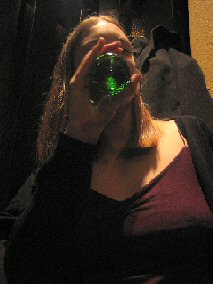
1. Charming, sophisticated company (pictured, demurely swigging a small but classy bottle of wine).
2. A pantomime donkey making an exit on a fly wire. Excellent. Thank you, Dario Fo (directing Rossini's 'The Journey to Reims' at the Finnish National Opera).

24 November 2006

A passion for a Passion

Does one ever fully recover from the emotion of theatrical performance? I cross-refer in this to Anna MR's blog entry on roles of theatre past.

In my 'current past' case, it was 18 years ago today, on 24 November 1988, at the Warwick Arts Centre, that we had the opening night of our university stage production of JS Bach's St John Passion in English. The performance was touted as the British stage première, being most often done as a concert piece in German. It was a semi-professional gig, as most of the soloists were fully fledged professionals on the opera and concert circuit. I was part of the dramatic chorus, a tight-knit group who wove choral harmonies into the action.

The show was a personal first in two other ways. It was the first theatre piece that I was in that was reviewed, and positively, in a national newspaper (The Sunday Telegraph, if I recall). It was also the first time on stage, in dress rehearsal, that I found myself with real tears flowing.

Back in the present, I have just this week, courtesy of Amazon, taken delivery of a CD of a recording of a different English language version. I have not listened to this music for many years, but had not heard three bars of Part 1 before remembering my tears at the end of the crucifixion scene ("It is finished"), and realising that the performance was still in me. Somewhere. An echo in time maybe, but very, very real.

09 November 2006

That stage direction

The Winter's Tale is a schizophrenic play. Up until near the end of Act III, there is an unrelenting tragic narrative in the best tradition of Othello or King Lear: the misguided protagonist who does not see the error of his ways until it is too late. From that point on, the pastoral springs into action, clearing the path to redemption. At the end, Hermione, having reportedly died in the tragic cycle, is apparently magically brought back to life upon the fulfilment of the prophecy of the Oracle.

In modern times, some people have difficulty coping with this internal shift of genre. Expectations of naturalism are partly to blame. Yet structurally, as an exploration of the diversity of emotional life, it makes perfect sense.

I will miss Clown. One of the main reasons that I like him, I think, is his involvement at the turn of the tide. Antigonus arrives in Bohemia, is warned by a mariner about the creatures of prey, and is chased off and torn apart by one. Clown witnesses. Meanwhile, the baby Perdita is found and rescued by the Old Shepherd. Clown witnesses.

My favourite moments of discovery came when exploring how the change from tragedy to pastoral comedy occurred. In my view (no doubt to be contested, for indeed, there are contesters abroad), there are three key moments in the process of the change: let's call them tragic completion, pivot, and comedic beginning. After these changes to the unfolding dramatic structure, the symmetry of a concluding courtly romance is all but inevitable.

The comedy, in my view, begins for real when Autolycus enters, singing a bawdy song. Shakespearean tragedies have comic characters, but they tend not to be rich in bawdy songs.

The pivot, in my view, comes with the Old Shepherd's speech to Clown, his son, after Antigonus is gone into the storm and Perdita is found: "thou mettest with things dying, I with things newborn". That has to be a clear signal that the winds of change have been blowing.

The tragic completion, in my view, must be our friend the bear. Shakespeare generally implied stage directions within spoken text, so the ones that he made explicit are of significance. "Exit pursued by a bear", in its brutal savagery, seems to punctuate the end of the tragedy.

In our production, a vicious rumour had it that some of the audience suspected that the white, furry bear was actually a sheep. How wonderfully appropriate! The schizophrenic change from tragic to pastoral is then concentrated into one schizophrenic image of bear-cum-sheep. In one symbolic moment, the genre changes and salvation is guaranteed.

The winter's tale? The bear is it!

07 November 2006

The Alexander Theatre

What a place! Too many modern performance spaces seem to be designed for cinema rather than live theatre. Aleksanterin teatteri is wonderfully traditional (1879) and has the works: wings, gantries, pulleys, flies, control box, ... the lot. It's a cultural jewel that the Finnish authorities should treasure more than they apparently do.

There is a surprising emotional warmth generated onstage by the theatre design, particularly on the extended apron covering the orchestra pit. The tight rows of red seats and the three levels of auditorium help, of course.

The depth of the stage ... my goodness! I first approached the space from the workshops behind upstage and it was like walking through a tunnel, with the proscenium opening out to the auditorium in the distance. Centre stage, things felt smaller but the audience still quite distant. At the forestage and extended apron, the power of the space was more apparent. One could just stand there and sing!

And the excitement, joys, and torments of our weekend with The Winter's Tale? Let it breathe. We'll tell the other tales anon.

03 November 2006

The Winter's Tale

The butterflies in my stomach resemble the paw-beats of a bear chasing across a Bohemian stormscape. Exit pursued by. It is almost time. There is a show to do.

Break a leg, everyone!

Normal service will be resumed as soon as possible.

31 October 2006

Into production

So here we are again. Theatre. Production week.

No matter how often I go through it, production week remains a heightened experience. The element of the unpredictable is so high, and the build-up of adrenalin so pronounced, that nothing in weeks like this looks or feels the same as at any other time.

The rehearsal period takes cast and crew through many phases. For me, though, this time just before opening divides quite clearly into two: before and after walking the space. This is particularly true when working an unfamiliar theatre. In the lead-up to getting in and feeling the space, the endless possibilities are the stuff of nightmares. Even in familiar surroundings, there is still a leap of faith in finally finding out how the space and the piece interact and change each other.

After the first encounter with the space, the gradual process of learning brings its own surprises, through get-in, technical, dress, and opening. The Brewhouse Theatre in Taunton had (maybe still has) a notorious squeaky board at one of the downstage sweet points. The guest stage at the Q Theatre in Helsinki, 'Puoli-Q', has an array of pillars that play merry hell with the sight lines. The size of the 670-seat auditorium at the Ruse Opera hits you right between the eyes.

Of these, I suspect that the last may be the closest to the experience that awaits us at the Aleksanterin teatteri in Helsinki. I have not yet walked that space, but it too has housed professional opera and therefore has appropriately sized stage and auditorium (470+). Right now, though, before stepping onto the boards and with lights-up less than a week away, looking forward to the space is like walking through fog at dusk.

26 October 2006

Mauna Kea

There is a scene in 'Dead Poets Society' where the teacher (Robin Williams) leaps up onto a desk and urges his schoolboy acolytes to see the world from a different perspective.

Desk nothing. Get thee to Mauna Kea. It must be one of the most breathtaking experiences of my life. Literally so, because the summit is so far up, at more than 4200 metres above sea level, that the altitude effect can be severe. I certainly had an unsteady moment or two this August, when moving and getting breath seemed to be the stuff of dreams.

But boy, was it worth it. The sense of sheer size and space; the whole world spread out below and the whole sky spread out above. The clarity of colour, the sunset's hues touching all, the shooting stars and constellations brighter than in any other sky. The compact white domes housing some of the most advanced telescopes on the planet. The totality defies words. As far as shifts in perspective are concerned, the effect has to be life-changing.

So as we approach The Winter's Tale, the biggest theatrical event in which I have performed for a good many years, I will try to remember. I will try to keep a sense of perspective. You may find me standing on a desk.

14 September 2006

On creating Clown

We are rehearsing William Shakespeare's The Winter's Tale. I am Clown.

This is something of a new venture for me. I've done a fair bit of theatre, including actually getting a degree in the stuff at some point in my increasingly misty past, but nothing like this. Recently I have been mostly cast in the role of a miserable, misguided, middle-aged man. Think Superintendent in Fo's Accidental Death of an Anarchist; Father in Pirandello's Six Characters in Search of an Author; Duke in Pratchett/Briggs' Wyrd Sisters; Moulsworth in Ustinov's Romanoff and Juliet. If you know any of those, you get the drift. They are all disturbed.

Clown is an innocent. He's not the fastest armadillo on the highway, certainly, but he has an essentially good heart. So now my challenge is to exorcise the spirits of productions past and get into rustic mode.

Maybe one of the hardest aspects is reversing other people's expectations. Clown has a bit of a love life, unlike some, and this includes the occasional roll in the hay with a shepherdess called Mopsa. In real life, the wonderful performer playing Mopsa is some twenty years younger than me. A recent set of photographs from rehearsals illustrated this very clearly, and now the group expectation seems to be for me to go down the dirty-old-man road of Pirandello's Father.

No, I have to shout. I am not Father, I am Clown.

Can I be Romeo next time, please?